Triangles Properties and Construction is one of the most important early geometry lessons for Grades 5–6.
Triangles are everywhere — in roofs, bridges, and art — and learning how to recognize and build them helps students understand the world of shapes all around us.
In this lesson, students will explore the five main types of triangles and learn how to identify each one by its sides and angles.
They’ll also practice drawing and measuring triangles step by step using simple tools such as a ruler, compass, and protractor.
To make learning easier, we’ve included a free printable PDF worksheet that parents and teachers can download.
It contains hands-on activities and guided exercises to help students practice at home or in class.
This resource supports independent learning and builds strong geometry foundations through clear explanations and engaging practice tasks.
By the end of this unit, students will be able to classify, label, and construct triangles with confidence — a key skill for all future geometry topics.
Table of Contents
What Is a Triangle?
A triangle is the simplest polygon. It has:
- 3 sides
- 3 vertices (corners)
- 3 angles
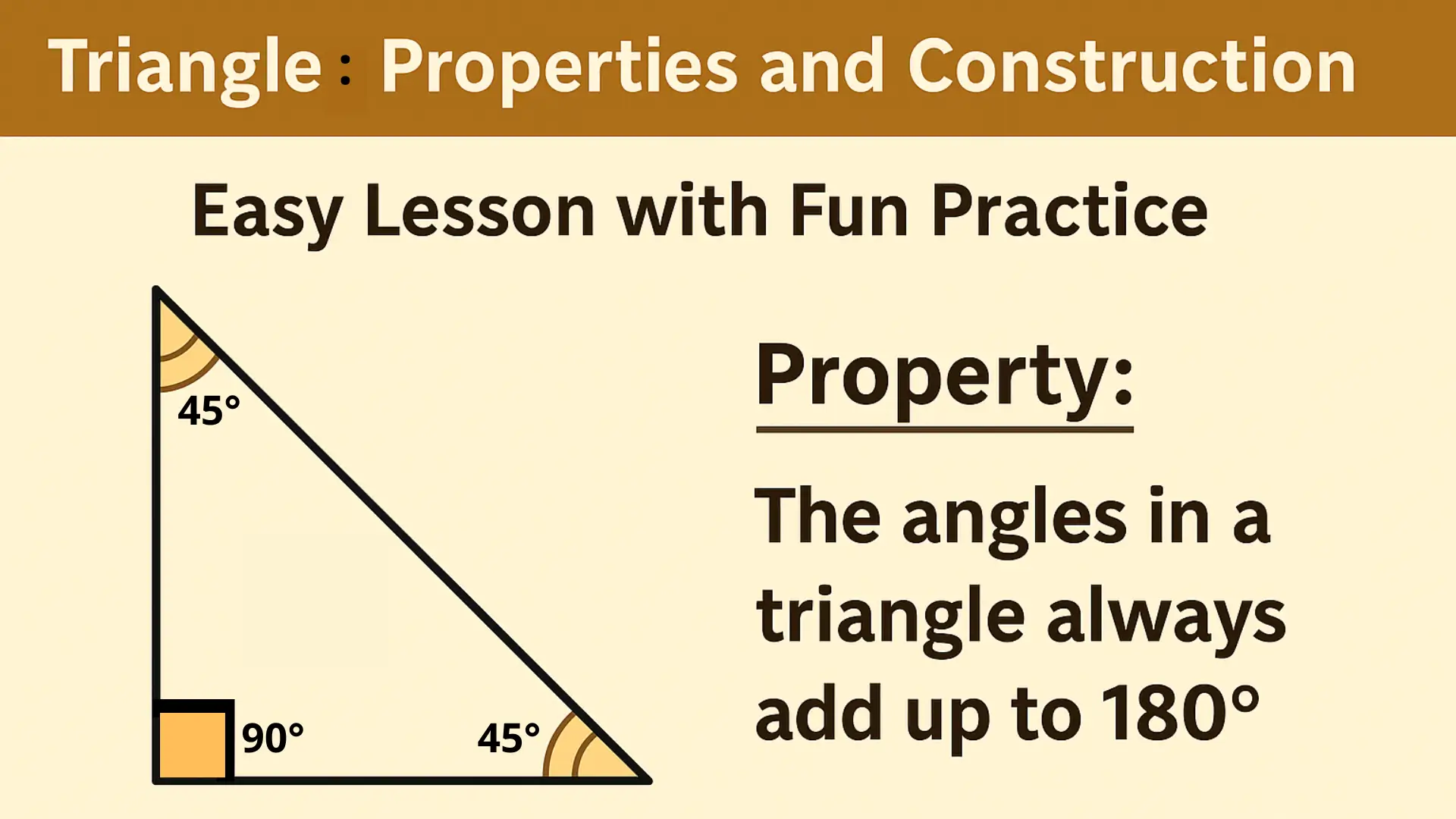
When we add the three angles of any triangle together, the total is always 180°.
Types of Triangles
Equilateral Triangle
- Sides: All three sides are equal.
- Angles: All three angles are equal, measuring 60° each.
- Property: It’s the most regular and balanced triangle — perfectly symmetrical in shape.

Example:
A triangle with sides 5 cm, 5 cm, 5 cm has three equal angles of 60°.
Isosceles Triangle
- Sides: Two sides are equal in length.
- Angles: The two base angles opposite these sides are also equal.
- Property: It looks like a triangle “standing on its legs.”
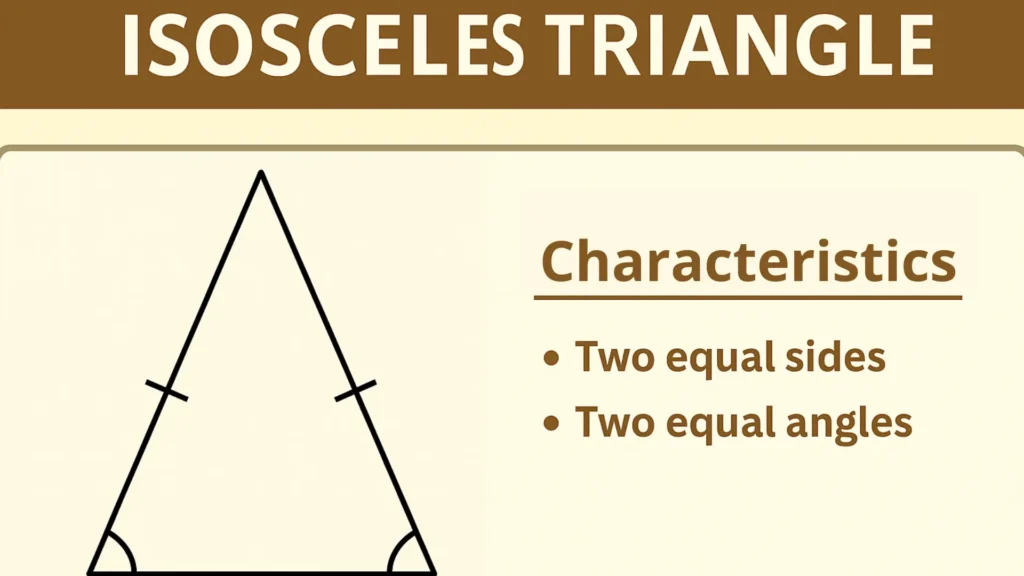
Example:
If the equal sides measure 4 cm and the base measures 6 cm, then the two base angles are equal.
Scalene Triangle
- Sides: All sides are of different lengths.
- Angles: All three angles have different measures.
- Property: It’s the most irregular triangle — no sides or angles are alike.
Example:
A triangle with sides 3 cm, 4 cm, and 5 cm is scalene.
Right Triangle
- Sides: It has one side that connects two other sides at a right angle (90°).
- Angles: One right angle (90°) and two smaller angles that add up to 90°.
- Property: It is called “right” because it represents half of a rectangle when you draw a diagonal.
Example:
A triangle with sides 3 cm, 4 cm, and 5 cm forms one right angle at the corner where the shorter sides meet.
Right Isosceles Triangle
- Sides: Two sides are equal.
- Angles: One right angle (90°) and two equal angles of 45° each.
- Property: It’s both a right triangle and an isosceles triangle — a special combination of both.
Example:
A triangle with two equal sides of 4 cm forms angles of 90°, 45°, and 45°.
How to Construct Triangles
Tools You Need
You will need a ruler, compass, and protractor (or right-angle tool).
Constructing an Equilateral Triangle
- Draw a base AB = 6 cm.
- Open the compass to 6 cm.
- Draw one arc from A and another from B — they meet at C.
- Connect A, B, and C.
Constructing an Isosceles Triangle
- Draw the base AB = 6 cm.
- Set the compass to 4 cm. Draw arcs from A and B.
- Label their intersection C. Connect A, B, and C.
Constructing a Scalene Triangle
- Draw AB = 5 cm.
- From A, draw an arc 4 cm; from B, draw an arc 6 cm.
- Their intersection is C. Connect A, B, and C.
Constructing a Right Triangle
- Draw the base AB = 6 cm.
- At A, use a right-angle tool to draw a 90° angle.
- Measure AC = 4 cm on the perpendicular line, then connect C to B.
Constructing a Right Isosceles Triangle
- Draw a right angle at A.
- Mark AB = AC = 4 cm.
- Connect points A, B, and C.
Common Mistakes
- Forgetting to measure sides and angles carefully.
- Confusing equilateral and isosceles triangles (three sides vs. two sides).
- Drawing triangles without using a ruler or compass — sides won’t match correctly.
- Forgetting to label points and equal sides.
- Assuming a larger triangle changes type — only the length ratios matter, not the size.
Practice Exercises
Exercise 1 – Classify by Sides
Write the name of each triangle:
(a) 5 cm, 5 cm, 5 cm → …………………..
(b) 4 cm, 4 cm, 6 cm → …………………..
(c) 3 cm, 4 cm, 5 cm → …………………..
Exercise 2 – Construct These Triangles
- Equilateral triangle with sides 6 cm.
- Isosceles triangle with base 6 cm and equal sides 4 cm.
- Scalene triangle with sides 3 cm, 4 cm, 5 cm.
- Right triangle with base 6 cm and height 4 cm.
- Right isosceles triangle with equal legs 4 cm.
Exercise 3 – Fill in the Blanks
a) A triangle with three equal sides is ……………………………………
b) A triangle with two equal sides is ………………………………………
c) A triangle with one right angle is ……………………………………….
d) A triangle with no equal sides is …………………………………………
e) A triangle with one right angle and two equal sides is …………..
Key Points to Remember
- A triangle has three sides and three angles.
- The sum of its angles is always 180°.
- Triangles can be classified by side lengths or angles.
- Always label points (A, B, C) and measure carefully.
Teacher’s Note
Dear students,
Geometry requires precision, focus, and patience.
Take your time when using your ruler and compass — draw carefully and always double-check your measurements.
Every mistake is a chance to learn and improve.
Practice often with the downloadable PDF worksheet: the more you practice, the more confident you’ll become with constructions.
If any part of this lesson feels unclear or if you’d like more practice worksheets, feel free to share your thoughts in the comments.
I regularly review your feedback and update the site with new lessons and printable resources to fit your learning needs.
Thank you for your curiosity and dedication — those are the real keys to success in mathematics!
Conclusion
In this lesson on Triangles Properties and Construction, you learned how to recognize the main types of triangles and how to draw them step by step with precision.
These skills will help you in many future geometry topics, including quadrilaterals and polygons.
Keep practicing with the exercises and the downloadable PDF worksheet to strengthen your understanding at your own pace.
Follow Courscoolenglish on Pinterest to discover new printable worksheets, classroom posters, and creative math ideas every week — all designed to make learning math clearer, easier, and more enjoyable!
FAQ : Triangles Properties and Construction
Why is it called a right triangle
Because it represents half of a rectangle when you draw a diagonal from one corner to the opposite corner.
Why are the base angles of an isosceles triangle equal
Because the two equal sides face two equal angles , when sides match, angles match too.
Why is the sum of the angles in a triangle always 180°
Because if you cut out the three angles of any triangle and place them side by side,
they line up to form a straight line, which measures 180°.
This rule is true for all triangles, no matter their size or shape.
How can you check if a triangle has a right angle
To check for a right angle, use a protractor or a right-angle tool (set square).
If one of the triangle’s angles matches the 90° corner of the tool, the triangle is a right triangle.
What’s the difference between an isosceles triangle and an equilateral triangle
An isosceles triangle has two equal sides and one side that’s different.
An equilateral triangle has three equal sides and three equal angles (60° each).
You can think of an equilateral triangle as a special kind of isosceles triangle.
Can a triangle have more than one right angle
No, it cannot.
A triangle can only have one right angle, because the sum of all three angles in a triangle is 180°.
If it had two right angles, the total would already be 180°, leaving no space for a third angle — so it wouldn’t be a triangle anymore!