

Factors and multiples are essential concepts for Grade 5 students as they help build a strong number sense. These ideas allow students to see how numbers are connected, understand multiplication and division better, recognize patterns, and solve real-world problems with more confidence.
In this lesson, students will learn what multiples are, what factors are, how to find them, and how they are related. They will also discover simple divisibility rules that make calculations faster and easier.
By the end of this lesson, students will be able to:
- Identify and generate multiples of a number
- Find all the factors of a given number
- Use factor pairs to check their work
- Apply divisibility rules to test numbers quickly
- Understand the connection between factors and multiples
This introduction prepares students for the step-by-step explanations and practice activities that follow in the rest of the lesson.
Table of Contents
2. What Are Multiples?
A multiple is the result of multiplying a number by 0, 1, 2, 3, and so on.
In Grade 5, students often learn multiples through skip-counting or repeated addition, which makes the idea easy to visualize.
Definition
A multiple of a number is a value you get when you multiply that number by a whole number.
Examples:
- Multiples of 3 → 0, 3, 6, 9, 12, 15, 18…
- Multiples of 5 → 0, 5, 10, 15, 20, 25…
- Multiples of 8 → 0, 8, 16, 24, 32, 40…
These lists go on forever because there is no largest multiple.
Students should remember that every number is a multiple of itself (for example: 7 is a multiple of 7).
How to Find Multiples
There are two easy methods:
1. Multiplying
Multiply the number by 0, 1, 2, 3, 4…
Example: Multiples of 6
6 × 0 = 0
6 × 1 = 6
6 × 2 = 12
6 × 3 = 18
6 × 4 = 24
2. Skip-Counting
Students can skip-count by the number:
6, 12, 18, 24, 30, 36…
Both methods create the same list of multiples.
Common Mistakes
- Thinking the list of multiples “ends” (it continues forever).
- Forgetting that 0 is always a multiple of every number.
- Confusing multiples with factors.
Quick Practice
- Write the first five multiples of 7.
- Which of these numbers are multiples of 4? → 12, 14, 16, 21, 24
- Is 45 a multiple of 5? Explain.
3. What Are Factors?
Factors are the numbers you can multiply together to get another number.
In other words, a factor divides a number without leaving a remainder.
For example:
12 ÷ 3 = 4 → there is no remainder
So 3 is a factor of 12, and so is 4.
How to Find Factors (Step-by-Step)
To find the factors of a number, follow this simple method:
- Start with 1 and the number itself
– Every whole number is divisible by 1 and itself.
– Example: For 24, start with 1 and 24. - Test numbers in order
– Try 2, then 3, then 4… and continue until you reach the halfway point. - Each time a number divides evenly, write down the factor pair
For example, to find the factors of 24:
1 × 24 = 24
2 × 12 = 24
3 × 8 = 24
4 × 6 = 24
- Stop when the factor you are testing becomes greater than the partner factor.
– This means you have found all factor pairs.
Factor Pairs Method (The Best Strategy)
Students often find factors more easily by looking for peers:
To find the factors of 24, look for pairs of numbers that multiply to 24:
1 and 24
2 and 12
3 and 8
4 and 6
So the factors of 24 are:
1, 2, 3, 4, 6, 8, 12, 24
Important Points
- 1 is a factor of every whole number.
- A number always has at least two factors: 1 and itself.
- Some numbers (like 12 or 24) have many factors.
- Other numbers (like 7 or 11) have only 2 factors: 1 and the number itself.
– These are called prime numbers.
Quick Practice
- List all the factors of 18.
- Is 5 a factor of 35? Why or why not?
- Which number has more factors: 20 or 15?
4. Relationship Between Factors and Multiples
Factors and multiples are closely connected. Understanding this relationship helps students check their work and solve problems more efficiently.
If a number is a factor of another number, then the second number is a multiple of the first.
This means:
- If A is a factor of B,
then B is a multiple of A.
And the opposite is also true:
- If B is a multiple of A,
then A is a factor of B.
Examples
3 and 12
3 × 4 = 12
- So, 3 is a factor of 12, and 12 is a multiple of 3.
5 and 2
5 × 4 = 20
- So, 5 is a factor of 20, and 20 is a multiple of 5.
6 and 18
6 × 3 = 18
- So, 6 is a factor of 18, and 18 is a multiple of 6.
How to see the connection
You can always check the relationship by asking:
- “Does multiplication get me from the smaller number to the larger number?”
- If yes → the smaller number is a factor, the larger number is a multiple.
Quick Check
Decide whether the following statements are true or false:
- If 4 is a factor of 16, then 16 is a multiple of 4.
- If 30 is a multiple of 6, then 6 is a factor of 30.
- If 9 is not a factor of 20, then 20 cannot be a multiple of 9.
(Answers will appear in the Answer Key section.)
Divisibility Rules (Grade 5)
Divisibility rules help students check quickly whether a number can be divided by another number without doing long division. These shortcuts make it easier to find factors and identify number patterns.
Below are the most important divisibility rules for grade 5, written in simple terms and followed by short examples.
Rule for 2
A number is divisible by 2 if it ends in 0, 2, 4, 6, or 8.
Examples: 18, 42, 100
Rule for 3
A number is divisible by 3 if the sum of its digits is a multiple of 3.
Example:
123 → 1 + 2 + 3 = 6 → 6 is a multiple of 3 → so 123 is divisible by 3.
Rule for 4
A number is divisible by 4 if the last two digits form a number that is a multiple of 4.
Examples:
312 → last two digits: 12 → divisible by 4
318 → last two digits: 18 → not divisible by 4
Rule for 5
A number is divisible by 5 if it ends in 0 or 5.
Examples: 45, 60, 85
Rule for 9
A number is divisible by 9 if the sum of its digits is a multiple of 9.
Example:
234 → 2 + 3 + 4 = 9 → divisible by 9
Rule for 10
A number is divisible by 10 if it ends in 0.
Examples: 80, 140, 320
Quick Review Table
| Number | Divisibility Rule | Example |
|---|---|---|
| 2 | Ends in 0, 2, 4, 6, 8 | 18 |
| 3 | Sum of digits is a multiple of 3 | 123 |
| 4 | Last two digits form a multiple of 4 | 312 |
| 5 | Ends in 0 or 5 | 45 |
| 9 | Sum of digits is a multiple of 9 | 234 |
| 10 | Ends in 0 | 80 |
Quick Practice
- Is 126 divisible by 2? By 3?
- Is 245 divisible by 5?
- Is 432 divisible by 9?
- Is 318 divisible by 4?
Common Errors to Avoid
When learning factors and multiple, many Grade 5 students make the same mistakes. Understanding these errors helps them avoid confusion and build stronger math skills.
1. Confusing factors and multiples
This is the most common mistake.
- Factors are the numbers you multiply to get another number.
- Multiples are the results of multiplication.
Example:
3 and 4 are factors of 12, but 12 is a multiple of 3 and 4.
2. Forgetting that 1 and the number itself are always factors
Students often list factors but forget:
- 1 is a factor of every whole number
- The number itself is also a factor
Example: Factors of 18 must include 1 and 18.
3. Thinking multiples have a limit
Some students think multiple “stop” somewhere.
Multiple goals go on forever:
6, 12, 18, 24, 30, 36, 42…
4. Not checking factor pairs
When finding factors, students sometimes list numbers randomly and miss some.
Using factor pairs helps prevent mistakes:
1×24, 2×12, 3×8, 4×6 → all factor pairs of 24.
5. Misunderstanding “divisible by”
If a student reads “24 is divisible by 6,” they may not realize it means:
- 6 is a factor of 24
- 24 is a multiple of 6
These statements express the same relationship in different ways.
Exercises : Factors and Multiples Practice
Find the Multiples
- Write the first five multiples of 6.
- Write the first five multiples of 9.
- Is 30 a multiple of 5? Explain your answer.
- Which of these numbers are multiples of 8?
16 – 20 – 24 – 32 – 40 – 42 - What is the least common multiple (LCM) of 4 and 6?
Find the Factors
- List all the factors of 18.
- List all the factors of 36.
- Is 7 a factor of 28? Explain.
- Use factor pairs to find all the factors of 24.
- Write the factor pairs of 40.
True or False
Write T for True and F for False.
- 20 is a multiple of 4.
- 7 is a factor of 30.
- All whole numbers have an infinite number of multiples.
- 1 is a factor of every whole number.
- 36 is a multiple of 6.
Divisibility Check
Use the divisibility rules to answer.
- Is 126 divisible by 2? by 3?
- Is 245 divisible by 5?
- Is 432 divisible by 9?
- Is 318 divisible by 4?
Word Problems
Problem 1
A teacher has 36 students and wants to create equal groups with no one left out.
What are all the possible group arrangements?
Problem 2
Emily has 45 stickers. She wants to divide them equally into packs with no leftover stickers.
What pack sizes can she choose?
Problem 3
A number is divisible by 3 and 5, but not divisible by 9.
Find a number between 50 and 100 that fits this rule.
Problem 4
Liam is skip-counting by 7. Write the next four numbers:
14, 21, 28, ……. , …… , ……. , …….
Problem 5
Sophie says that 42 has only four factors.
Is she correct? Explain by listing all the factors of 42.
Conclusion
Learning factors and multiples is an essential step for Grade 5 students to build strong number sense. These concepts help them understand how numbers are connected, make mental calculations easier, and prepare them for more advanced topics such as prime numbers, least common multiples (LCM), and greatest common factors (GCF).
With the explanations, examples, exercises, and the downloadable worksheet provided in this lesson, students now have the tools they need to practice confidently. Regular review will help them become faster, more accurate, and more comfortable working with numbers in real-world situations.
For the next step, students can continue by exploring prime numbers and composite numbers, or by practicing LCM and GCF to deepen their understanding.
If you enjoyed this lesson on factors and multiples, don’t forget to save it on Pinterest for quick access! Pin our step-by-step explanations, classroom-friendly visuals, and the free printable worksheet so you can return to it anytime. Perfect for Grade 5 teachers, homeschooling parents, and students who want clear, simple math support.
Teacher’s Note
This lesson was designed to give Grade 5 students a clear, structured, and accessible introduction to factors and multiples.
The examples and exercises follow a gradual progression, making the topic suitable for whole-class instruction, small-group reinforcement, or independent practice.
Feel free to use the downloadable worksheet as:
- a classroom activity,
*homework, - a warm-up exercise,
- or a quick assessment tool.
If your students struggle with factors, remind them to use factor pairs (1 × n, 2 × n, 3 × n…).
If they struggle with multiples, encourage them to use skip-counting or multiplication tables.
Consistent practice and simple strategies make a big difference.
You can also pair this lesson with future units on prime numbers, LCM, and GCF for deeper mastery.
Download the Worksheet (PDF)
Download the complete Factors and Multiples PDF worksheet to help your Grade 5 students practice confidently.
It includes clear explanations, guided examples, practice exercises, a word problem, and a full answer key.
This worksheet is ideal for:
- independent practice at home,
- classroom reinforcement,
- math centers or stations,
- small-group interventions,
- or quick revision before a test.
Factors and Multiples: Grade 5 Worksheet (PDF)
Click the link below to download the free PDF:
FAQ : Frequently Asked Questions
Is every number a multiple of 1?
Yes. Every whole number is a multiple of 1 because you can always make it using a multiplication with 1.
For example:
1 × 7 = 7 → so 7 is a multiple of 1.
1 × 25 = 25 → so 25 is a multiple of 1.
Can a number be both a factor and a multiple?
Yes.
Example:
• 6 is a multiple of 3 (because 3 × 2 = 6).
• 6 is also a factor of 12 (because 12 ÷ 6 = 2).
A number is always a factor and a multiple of itself.
Example: 8 is a factor of 8 and a multiple of 8.
Does every number have the same number of factors?
No.
Some numbers have only two factors (like 11 → 1 and 11).
Other numbers have many factors (like 24 → 1, 2, 3, 4, 6, 8, 12, 24).
Why is zero not a factor of any number?
Because you can’t divide by zero.
For example, “36 ÷ 0” is impossible in math.
So zero cannot be a factor of any number.
Can a number have unlimited multiples?
Yes.
Multiples go on forever.
Example: multiples of 5 include 5, 10, 15, 20, 25… and they continue without stopping.
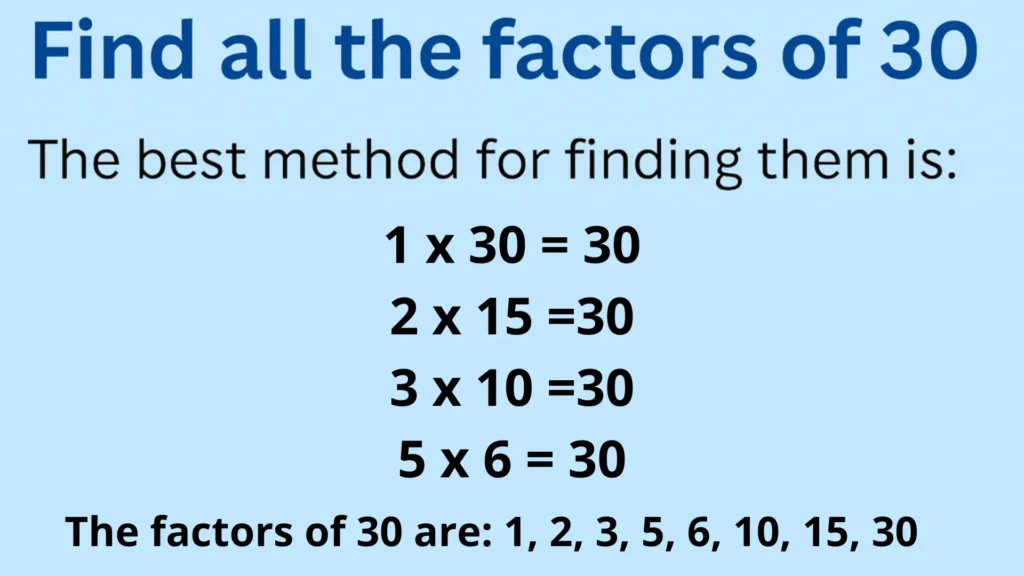
What is the easiest way to find all the factors of a number?
Use factor pairs.
Example with 30:
1 × 30
2 × 15
3 × 10
5 × 6
So the factors of 30 are 1, 2, 3, 5, 6, 10, 15, 30.
When the pairs start repeating or crossing, you stop.
What’s the difference between a factor and a multiple?
• A factor goes into a number exactly.
Example: 4 is a factor of 20 because 20 ÷ 4 = 5.
• A multiple comes out of a multiplication.
Example: 20 is a multiple of 4 because 4 × 5 = 20.
Why do we use divisibility rules?
Because they help you check quickly if a number has a factor without doing long division.
Example:
A number ending in 0 or 5 is divisible by 5.
A number ending in 0 is divisible by 10.
Can a number have only one factor?
No.
Every whole number has at least two factors: 1 and itself.
Example:
• 13 → factors: 1 and 13
• 17 → factors: 1 and 17


1 thought on “Factors and Multiples for Grade 5: Complete Guide with Examples and Worksheets”