Map scale (1:n) is a way to represent large real-world distances on a map using smaller measurements. When you look at a map, the distance you measure with a ruler is not the real distance. The map scale tells you how map distance and real distance are related.
In this lesson, you will learn how to use map scale (1:n) to find the real distance between two places or the distance shown on a map. You will work step by step using proportional reasoning, unit conversions, and scale drawings, just like in Grade 6 math textbooks.
By the end of this lesson, you will be able to read a map scale correctly, set up a proportion, and solve real-life problems involving maps, plans, and scale drawings.
Table of Contents
What Is a Map Scale (1:n)?
A map scale shows the relationship between distances on a map and distances in the real world. It tells you how many units in real life are represented by 1 unit on the map.
When a map scale is written as 1:n, it means:
1 unit on the map = n units in real life
The units must be the same on both sides. That is why distances are usually converted into centimeters before calculating.
For example, if the scale is 1:80 000, then:
- 1 cm on the map represents 80,000 cm in real life
This relationship is proportional, which means the same multiplication or division applies to both the map distance and the real distance.
Understanding the meaning of map scale (1:n) is the first step before setting up proportions and solving distance problems.
How to Find Real Distance Using a Map Scale
To find the real distance using a map scale (1:n), you follow the same steps every time. This method is based on proportional reasoning.
Step 1: Read the map scale
Start by identifying the scale written on the map.
If the scale is 1:n, then:
- 1 cm on the map = n cm in real life
This value is called the reference scale.
Step 2: Write the proportional relationship
Write the relationship between the reference distance and the measured distance on the map.
- 1 cm on the map → measured distance on the map
This step shows how many times larger the measured distance is compared to 1 cm.
Step 3: Apply the same proportion to real distance
Because the relationship is proportional, apply the same multiplication to the real distance.
- n cm in real life → n × (same factor)
This gives the real distance in centimeters.
Step 4: Convert units if needed
Real distances are often required in meters or kilometers.
Use unit conversions:
- 100 cm = 1 m
- 100,000 cm = 1 km
Convert your final answer to the required unit.
How to Find Map Distance from Real Distance
Sometimes, you are given the real distance between two places and asked to find the distance on the map. This situation also uses map scale (1:n) and proportional reasoning.
Step 1: Read the map scale
Start by identifying the scale.
If the scale is 1:n, then:
- 1 cm on the map = n cm in real life
Step 2: Convert the real distance into centimeters
Before setting up the proportion, make sure the real distance is expressed in centimeters.
This step is important because the scale compares distances using the same unit.
Step 3: Set up the proportional relationship
Write the reference relationship and the given real distance.
- n cm in real life → given real distance
This shows how many times larger the given real distance is compared to the reference value.
Step 4: Apply the same proportion to the map
Apply the same operation to the map distance.
- 1 cm on the map → map distance
This gives the distance that should be measured on the map.
Step 5: Check your result
A map distance should always be much smaller than the real distance.
If your result seems too large, check your unit conversions.
This method is used in scale drawings, maps, and plans, and follows the same logic taught in Grade 6 math classes.
Common Mistakes with Map Scale (1:n)
When working with map scale (1:n), students often make the same types of mistakes. Knowing these mistakes helps you avoid them.
Mistake 1: Not using the same units
A common error is forgetting to convert distances into the same unit.
Since map scale compares distances in the same unit, real distances must usually be converted into centimeters before calculating.
Mistake 2: Mixing up map distance and real distance
Some students confuse the distance measured on the map with the real distance.
Always identify clearly:
- what is given (map distance or real distance)
- what you are asked to find
Mistake 3: Using the wrong operation
- Multiply when finding real distance from map distance
- Divide when finding map distance from real distance
Choosing the wrong operation leads to incorrect results.
Mistake 4: Forgetting to convert the final answer
Sometimes the calculation is correct, but the answer is left in centimeters when the problem asks for meters or kilometers.
Always read the question carefully and convert the final answer if needed.
Avoiding these mistakes will help you solve map scale (1:n) problems accurately and with confidence.
Practice Problems (Grade 6)
Use the map scale (1:n) to answer each question. Show your work and convert units when needed.
Problem 1: Find Real Distance
A map has a scale of 1:50,000.
The distance between two points on the map is 6 cm.
- Find the real distance in meters.
Problem 2: Find Map Distance
The real distance between two places is 12 km.
The map scale is 1:200 000.
- Find the distance on the map in centimeters.
Problem 3: Find the Scale
On a map, a road measures 4 cm.
The real distance of the road is 2 km.
- Write the map scale in the form 1:n.
Problem 4: Scale Drawing
A scale drawing uses a scale of 1:1,000.
A park path measures 9 cm on the drawing.
- Find the real length of the path in meters.
Problem 5: Check Your Reasoning
A student finds a map distance of 150 cm for a real distance of 5 km using a map scale.
- Explain why this answer does not make sense.
Worked Solutions (Step-by-Step Answers)
Solution to Problem 1: Find Real Distance
Map scale: 1:50,000
Map distance: 6 cm
Step 1: Use the map scale
1 cm on the map represents 50,000 cm in real life.
Step 2: Apply proportional reasoning
6 cm represents:
50,000 × 6 = 300,000 cm
Step 3: Convert units
300,000 cm = 3,000 m
Answer: The real distance is 3,000 meters.
Solution to Problem 2: Find Map Distance
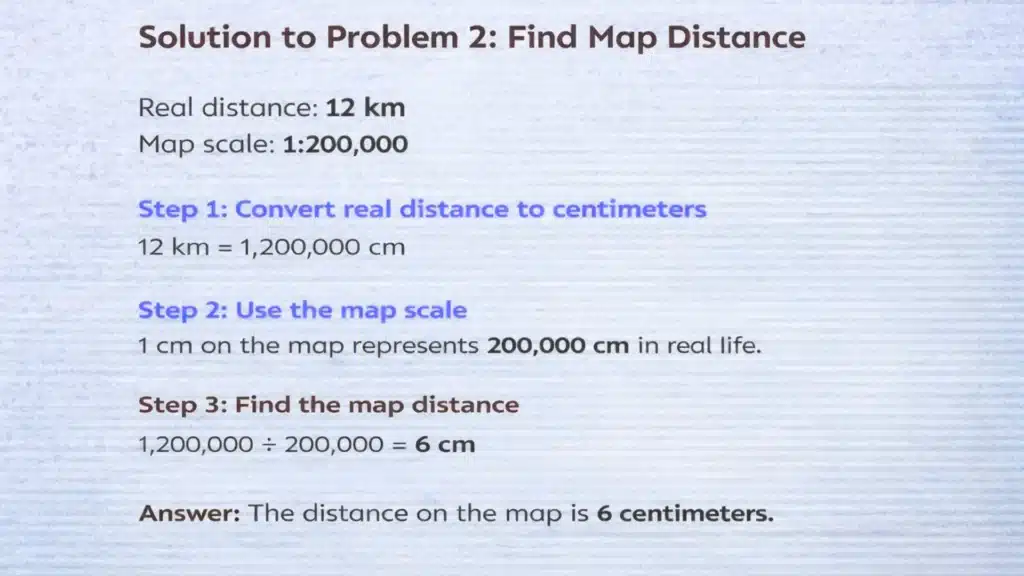
Real distance: 12 km
Map scale: 1:200,000
Step 1: Convert real distance to centimeters
12 km = 1,200,000 cm
Step 2: Use the map scale
1 cm on the map represents 200,000 cm in real life.
Step 3: Find the map distance
1,200,000 ÷ 200,000 = 6 cm
Answer: The distance on the map is 6 centimeters.
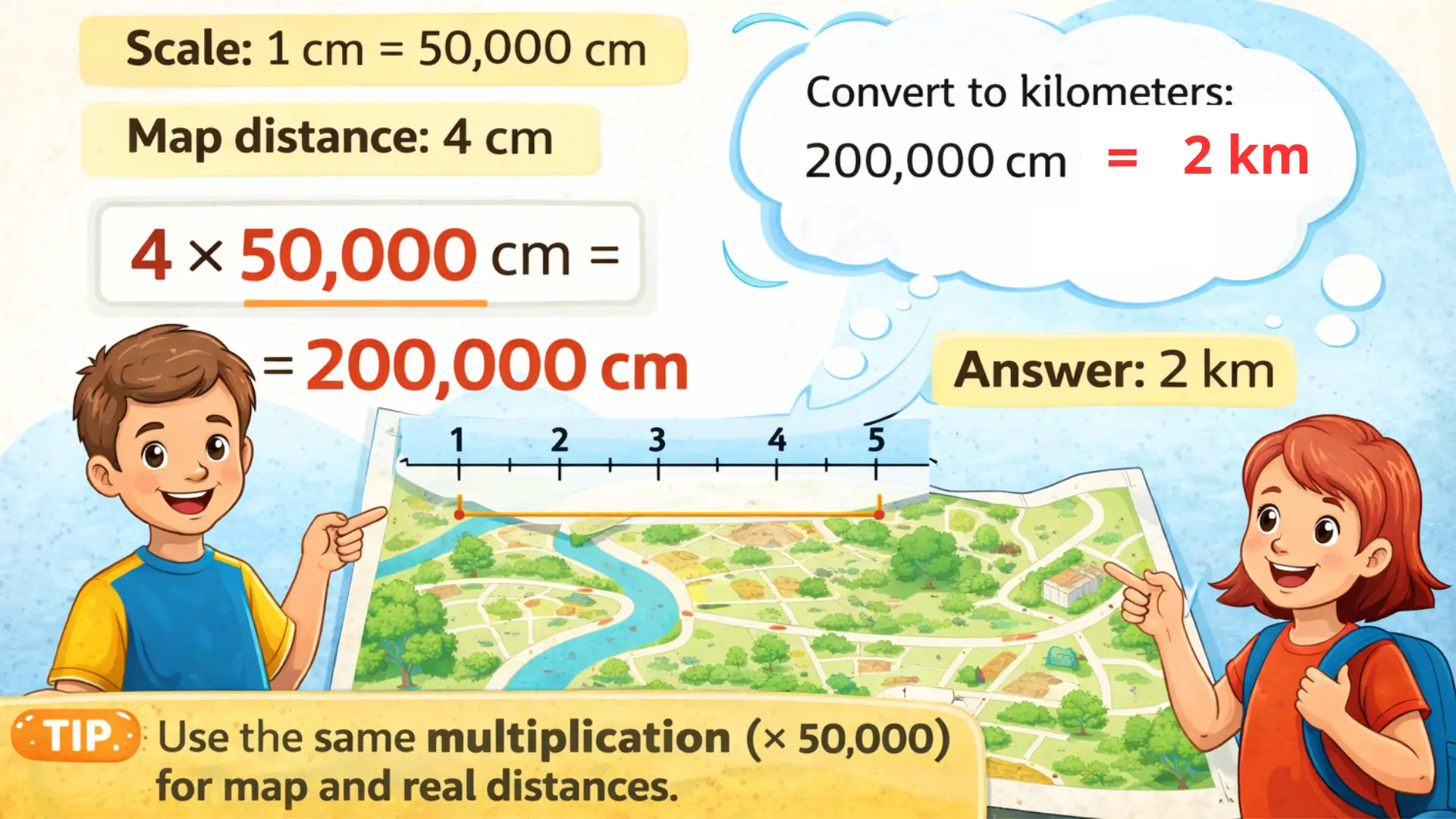
Solution to Problem 3: Find the Scale
Map distance: 4 cm
Real distance: 2 km
Step 1: Convert real distance to centimeters
2 km = 200,000 cm
Step 2: Set up the relationship
4 cm on the map represents 200,000 cm in real life.
Step 3: Find the unit rate
Divide both sides by 4:
1 cm represents 50,000 cm
Answer: The map scale is 1:50,000.
Solution to Problem 4: Scale Drawing
Map scale: 1:1,000
Map distance: 9 cm
Step 1: Use the scale
1 cm on the drawing represents 1,000 cm in real life.
Step 2: Multiply
9 × 1,000 = 9,000 cm
Step 3: Convert units
9,000 cm = 90 m
Answer: The real length is 90 meters.
Solution to Problem 5: Check Your Reasoning
Real distance: 5 km
Map distance found: 150 cm
Step 1: Compare sizes
5 km is a very large real distance. A map distance of 150 cm (1.5 meters) is too large to be realistic.
Step 2: Identify the error
The student likely forgot to convert units or used the wrong operation.
Answer: The result does not make sense because a map distance should be much smaller than the real distance.
Teacher Tips / Parent Tips
For Teachers
- Emphasize that map scale (1:n) is a proportional relationship. Encourage students to start every problem by identifying what 1 unit on the map represents in real life.
- Require students to convert all distances to the same unit before calculating. This prevents most common errors.
- Model problems step by step and ask students to explain their reasoning using complete sentences.
- Use visual aids such as maps, scale drawings, and rulers to help students connect abstract numbers to real-world distances.
- Encourage estimation to check reasonableness. A map distance should always be much smaller than the real distance.
For Parents
- When helping at home, ask your child to explain what the map scale means in their own words.
- Practice with simple examples using maps, plans, or scale drawings found online or in books.
- Remind your child to check units carefully and to convert centimeters, meters, and kilometers correctly.
- Encourage your child to slow down and follow the same steps for every problem. Consistency builds confidence and accuracy.
Common Errors with Map Scale (1:n)
When working with map scale (1:n), students often make similar mistakes. Being aware of these errors helps avoid them.
Error 1: Not converting units
A frequent mistake is forgetting to convert distances into the same unit.
Since map scale compares distances using the same unit, real distances must usually be converted into centimeters before solving the problem.
Error 2: Confusing map distance and real distance
Some students mix up the distance measured on the map with the real-world distance.
Always identify clearly:
- what is given (map distance or real distance)
- what you are asked to find
Error 3: Using the wrong operation
- Multiply when finding real distance from map distance
- Divide when finding map distance from real distance
Using the wrong operation leads to incorrect answers.
Error 4: Forgetting to convert the final answer
Even when the calculation is correct, students sometimes leave the answer in centimeters when the problem asks for meters or kilometers.
Always read the question carefully and convert the final answer to the required unit.
Error 5: Not checking if the answer makes sense
A map distance should always be much smaller than the real distance.
If the result seems too large, there is likely a mistake in unit conversion or calculation.
Teacher’s Note
Working with map scale (1:n) may feel challenging at first, but it becomes much easier when you follow a clear method. Take your time to read the scale carefully, convert units correctly, and think about what the numbers represent.
Mistakes are part of learning. Each problem you solve helps you better understand proportional reasoning and real-world applications of math. With practice and careful thinking, you will gain confidence and accuracy when working with maps and scale drawings.
Keep practicing, and remember that math is not just about numbers, but about understanding relationships.
Download the Printable PDF
You can download a printable PDF version of this lesson on map scale (1:n).
The PDF includes the lesson explanation, step-by-step methods, practice problems, and worked solutions.
This printable resource is ideal for classroom use, homework practice, or independent study. It is formatted for easy printing and helps students review key concepts at their own pace.
Download the PDF to practice map scale problems and strengthen your understanding of real-world distance relationships.
Conclusion
Understanding map scale (1:n) helps you connect mathematics to real-world situations such as maps, plans, and scale drawings. By using proportional reasoning and correct unit conversions, you can find real distances, map distances, and determine the scale of a map accurately.
With regular practice and a clear step-by-step method, map scale problems become easier and more meaningful. This lesson and its printable resources can also be saved or shared on Pinterest as a helpful reference for reviewing map scale concepts anytime.
Keep practicing, and use the printable PDF to strengthen your understanding of map scale.
FAQ : Map Scale (1:n)
What does map scale (1:n) mean
Map scale (1:n) means that 1 unit on the map represents n units in real life. For example, if the scale is 1:50,000, then 1 cm on the map represents 50,000 cm in real life.
Why do we need to convert units when using map scale
Unit conversion is necessary because map scale compares distances using the same unit. Real distances are often given in meters or kilometers and must be converted to centimeters before calculating.
When do I multiply and when do I divide
You multiply when finding real distance from a map distance.
You divide when finding map distance from a real distance.
How can I check if my answer makes sense
A map distance should always be much smaller than the real distance. If the map distance is very large, there is likely a mistake in unit conversion or calculation.
Is map scale the same as scale drawings
Yes. Map scale and scale drawings both use proportional reasoning to represent real objects or distances at a smaller size.
Why is map scale important in real life
Map scale is used to read maps, understand plans, measure distances between places, and interpret scale drawings in everyday situations.