Building strong number sense starts with 4th Grade Place Value, an essential math skill for students working with larger whole numbers. Understanding what each digit represents and how its position affects its value helps students read, write, and work with numbers accurately.
In this lesson, students will learn how place value works through the hundred-thousands place. They will practice identifying the position and value of digits and learn how to represent numbers in standard, word, and expanded forms.
These skills are important for developing a strong understanding of whole numbers and preparing students for more advanced math concepts.
This article also includes place value exercises and a free printable PDF that can be used for classroom practice, homework, review, or additional practice at home.
Table of Contents
What Is Place Value?
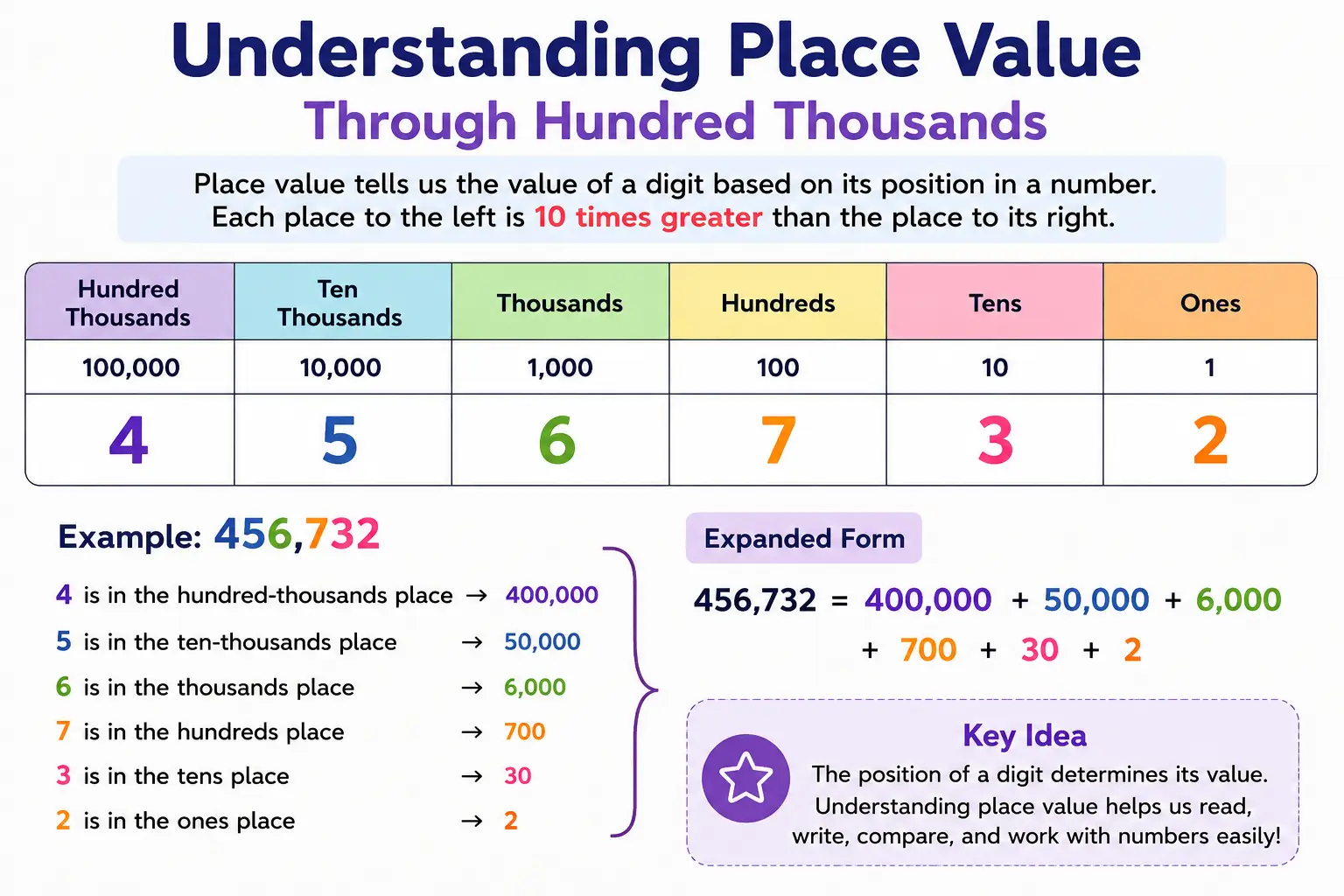
Place value is the value a digit has because of its position in a number. In 4th grade, students work with numbers through the hundred-thousands place and learn to identify the value of each digit.
The position of each digit tells us how much it represents. Starting from the right, the places are ones, tens, hundreds, thousands, ten thousands, and hundred thousands.
For example, consider the number 456,732.
The digit 4 is in the hundred-thousands place, so its value is 400,000.
The digit 5 is in the ten-thousands place, so its value is 50,000.
The digit 6 is in the thousands place, so its value is 6,000.
The digit 7 is in the hundreds place, so its value is 700.
The digit 3 is in the tens place, so its value is 30.
The digit 2 is in the ones place, so its value is 2.
Understanding the position and value of each digit makes it easier to read, write, compare, and represent larger numbers.
Place Value Chart
A place value chart can help students see how each digit contributes to a number.
| Hundred Thousands | Ten Thousands | Thousands | Hundreds | Tens | Ones |
|---|---|---|---|---|---|
| 4 | 5 | 6 | 7 | 3 | 2 |
For 456,732, the digits represent:
400,000 + 50,000 + 6,000 + 700 + 30 + 2
This is called the expanded form of the number.
Learning to move between the different place values is an important step toward understanding larger numbers and working accurately with them.
Standard Form, Word Form, and Expanded Form
A number can be represented in different forms. Learning these forms helps students understand the value of each digit and move easily between numbers and words.
Standard Form
The standard form is the usual way of writing a number using digits.
For example:
305,023
This number has 3 hundred-thousands, 0 ten-thousands, 5 thousands, 0 hundreds, 2 tens, and 3 ones.
Word Form
The word form writes the number using words.
For example:
305,023 = three hundred five thousand, twenty-three
Students should pay attention to zeros because a zero shows that a particular place has no value.
Expanded Form
The expanded form shows the value of each digit separately.
For example:
305,023 = 300,000 + 5,000 + 20 + 3
The three forms represent the same number:
Standard form: 305,023
Word form: three hundred five thousand, twenty-three
Expanded form: 300,000 + 5,000 + 20 + 3
Practicing these three forms helps students recognize numbers through the hundred-thousands place and understand how each digit contributes to the total value.
Finding the Value of a Digit
The position of a digit determines its value in a number. To find the value of a digit, first identify the place where the digit is located and then determine how many units that place represents.
For example, consider the number 79,843.
The digit 9 is in the thousands place. Therefore, its value is:
9 × 1,000 = 9,000
The value of 9 is 9,000, not simply 9.
The same method can be used with larger numbers. For example, in 179,824, each digit has a different value depending on its position.
Understanding the value of individual digits helps students read numbers correctly, write them in expanded form, and understand how numbers are built.
Using Place Value in Real-Life Situations
Place value is not only used when reading and writing numbers. It also helps students understand information presented in tables, charts, and everyday situations.
For example, when a table shows different numbers, students can use place value to identify the value of a digit, compare numbers, and represent a number in different forms.
Suppose a table shows the number 24,559. Students can identify the digit in the thousands place, write the number in word form, or express it in expanded form.
Place value can also be used when working with prices. Students can add prices, identify the value of digits in a number, and represent the result in standard, word, or expanded form.
These activities help students connect place value to practical situations while strengthening their understanding of numbers.
Reading and Writing Numbers in Different Forms
A number can be represented in standard form, word form, or expanded form. Students can practice changing a number from one form to another while keeping the same value.
For example:
Standard form: 305,023
Word form: three hundred five thousand, twenty-three
Expanded form: 300,000 + 5,000 + 20 + 3
Students can also start with an expanded form or a word form and convert it into standard form. Practicing these conversions helps students understand how each digit contributes to the total value of a number.
This skill is especially important when working with numbers through the hundred-thousands place because students need to recognize the value represented by each digit.
Using Base-Ten Blocks to Represent Numbers
Base-ten blocks provide a visual way for students to understand the value of each digit in a number. Each type of block represents a different place value, helping students see how numbers are composed.
For example, a number can be represented using blocks for thousands, hundreds, tens, and ones. Students can then use the model to write the number in standard form, expanded form, and word form.
For numbers through the hundred-thousands place, this visual representation helps students connect the position of each digit with its actual value. The BigLearners worksheets use base-ten block models and ask students to represent the same number in different forms.
Working with base-ten blocks can make place value easier to understand because students can see the relationship between the different place values rather than simply memorizing them.
Recognizing Number Patterns
Place value can also help students recognize patterns in numbers. By looking at how the digits change from one number to the next, students can identify the rule used to create a sequence.
For example, consider the sequence:
249, 269, 289, …
The numbers increase by 20 each time. Students can use this pattern to find the next numbers in the sequence.
Recognizing number patterns helps students pay attention to the value and position of digits. It also encourages them to look for relationships between numbers and explain the rule they observe.
4th Grade Place Value: Comparing and Understanding Numbers
Understanding 4th Grade Place Value helps students compare numbers and recognize the value of each digit. When students understand the position of digits, they can determine which numbers are greater or smaller and explain their reasoning.
Students can use the standard, word, and expanded forms of numbers to compare their values. They can also look at individual digits and their positions to identify differences between numbers.
For example, when comparing two numbers, students should first look at the digit in the greatest place-value position. If those digits are the same, they can move to the next place until they find a difference.
This practice strengthens students’ understanding of place value and helps them work confidently with numbers through the hundred-thousands place.
4th Grade Place Value: Building and Comparing Numbers
Students can use their understanding of place value to build numbers and determine which numbers are greater or smaller. Looking at the digits from left to right helps students compare numbers accurately.
For example, compare 458,216 and 485,216.
Both numbers have the same digit in the hundred-thousands place. The next digits are 5 and 8.
Since 8 is greater than 5, we know that:
458,216 < 485,216
Students can also build numbers using given digits. For example, if they are given the digits 3, 4, 5, and 6, they can arrange them to create the smallest or largest possible number, depending on the question.
This type of activity encourages students to use place value rather than simply looking at the individual digits.
4th Grade Place Value: Solving Number Problems
Place value can be used to solve problems involving larger whole numbers. Students can use the value and position of digits to find a number, change a number, or determine how a number changes when a value is added or subtracted.
For example, consider the number 45,899.
If we add 100, the hundreds place increases by one:
45,899 + 100 = 45,999
Students can also use given digits to create the smallest or largest possible number. If the digits are 3, 4, 5, and 6, the smallest number is 3,456, while the largest number is 6,543.
These problems encourage students to apply their understanding of place value rather than simply identify individual digits. They also provide useful practice before moving on to more challenging whole-number problems.
4th Grade Place Value: Applying Place Value to Everyday Problems
Place value is useful when working with numbers found in everyday situations. Students can use their place value skills to read information, identify the value of digits, compare amounts, and work with numbers presented in tables or charts.
For example, a table might show the number of people registered for an activity during different months. Students can identify the value of a digit, determine which number is greater, or write one of the numbers in another form.
Place value can also be used when working with prices. Students can add amounts and then represent the total in standard, word, and expanded forms.
4th Grade Place Value: Identifying the Value of Each Digit
A digit can have a different value depending on where it appears in a number. Students can use the place-value position to determine the value of each digit.
For example, consider the number 179,824.
The value of each digit is:
1 = 100,000
7 = 70,000
9 = 9,000
8 = 800
2 = 20
4 = 4
When students identify the value of every digit, they can also use those values to write the number in expanded form:
179,824 = 100,000 + 70,000 + 9,000 + 800 + 20 + 4
This practice helps students connect each digit to its position and understand how the different place values make up the whole number.
4th Grade Place Value: Practicing Number Patterns
Number patterns give students another opportunity to apply their understanding of place value. By looking at how a number changes from one term to the next, students can identify the pattern and use it to find missing numbers.
For example:
1,234, 1,244, 1,254, 1,264, ______
The pattern increases by 10 each time.
The next number is:
1,274
Students can also work with larger numbers and identify patterns involving hundreds, thousands, or other place values.
Finding number patterns helps students recognize how changes in a particular place affect the value of a whole number.
4th Grade Place Value: Reviewing What You Have Learned
Place value helps students understand how numbers are organized and how the value of each digit depends on its position. By practicing different place-value skills, students can become more confident when working with larger whole numbers.
In this lesson, students have practiced identifying the place and value of digits, writing numbers in standard, word, and expanded forms, using base-ten models, comparing numbers, building numbers, and recognizing number patterns.
Before moving on to the exercises, students can review these key ideas:
A digit’s position determines its value.
Standard form uses digits to write a number.
Word form writes a number using words.
Expanded form shows the value of each digit separately.
Place-value models can help represent numbers visually.
Keeping these ideas in mind will help students approach the practice exercises with a clear understanding of 4th Grade Place Value.
4th Grade Place Value Practice
Now it is time to practice what you have learned. These exercises will help you apply your understanding of 4th Grade Place Value through the hundred-thousands place.
Exercise 1: Identify the Place Value
Identify the place of the bold digit in each number.
a) 37,482
b) 524,619
c) 81,635
d) 294,718
e) 46,250
Exercise 2: Find the Value of the Digit
Write the value of the bold digit in each number.
a) 46,215
b) 732,408
c) 85,921
d) 216,475
e) 39,506
Exercise 3: Write the Number in Expanded Form
Write each number in expanded form.
a) 52,314
b) 306,725
c) 480,091
d) 715,640
e) 902,108
Exercise 4: Write the Number in Standard Form
Write each number in standard form.
a) 40,000 + 6,000 + 300 + 20 + 5
b) 300,000 + 20,000 + 7,000 + 400 + 8
c) 500,000 + 9,000 + 60 + 2
d) 700,000 + 4,000 + 500 + 30 + 9
Exercise 5: Write the Number in Word Form
Write each number in word form.
a) 34,205
b) 108,430
c) 250,016
d) 604,700
Exercise 6: Write the Number in Two Other Forms
Write each number in the two other forms.
a) 72,415
b) three hundred six thousand, twenty-eight
c) 400,000 + 30,000 + 700 + 6
Exercise 7: Compare the Numbers
Compare each pair of numbers. Write >, <, or =.
a) 45,620 ___ 45,260
b) 308,415 ___ 380,415
c) 620,090 ___ 620,090
d) 705,214 ___ 705,241
Exercise 8: Complete the Number Pattern
Find the pattern and write the next three numbers.
a) 1,250, 1,350, 1,450, ______, ______, ______
b) 24,500, 24,600, 24,700, ______, ______, ______
c) 315,000, 325,000, 335,000, ______, ______, ______
Exercise 9: Place Value Challenge
Answer each question.
a) What digit is in the hundreds place in 48,726?
b) What is the value of the digit 6 in 263,415?
c) What is 100 more than 45,899?
d) What is 1,000 less than 306,250?
e) Use the digits 2, 4, 5, and 8 to make the smallest possible four-digit number. Then write the number in expanded form.
Exercise 10: Apply Place Value to a Real-World Problem
A school library has 125,436 books.
a) What digit is in the ten-thousands place?
b) What is the value of the digit 5?
c) Write the number in expanded form.
d) Write the number in word form.
e) If the library receives 1,000 more books, what will the new total be?
Free 4th Grade Place Value PDF
Need more practice with place value? Download the free printable PDF to give students additional practice with identifying place values, finding the value of digits, writing numbers in different forms, and solving place value problems.
The PDF can be used for classroom practice, homework, math centers, review, or extra practice at home.
Related 4th Grade Math Resources
Once students understand place value, they can continue practicing other whole-number skills that build on this foundation.
Explore more 4th grade math resources to help students strengthen their number sense and develop confidence with larger numbers.
More Math Skills to Practice
Reading and writing whole numbers
Comparing and ordering numbers
Rounding whole numbers
Addition and subtraction with larger numbers
Number patterns
Solving whole-number word problems
These skills give students more opportunities to apply their understanding of numbers and prepare them for more advanced 4th grade math concepts.
Conclusion
Understanding 4th Grade Place Value is an important step in helping students work confidently with larger whole numbers.
By identifying the position and value of each digit, students can read, write, compare, and represent numbers in standard, word, and expanded forms. They can also use place value to recognize number patterns and solve everyday math problems.
With regular practice and clear examples, students can strengthen their number sense and build a strong foundation for more advanced math skills.
Use the free printable PDF included with this lesson to give students additional practice with place value through the hundred-thousands place.
Looking for more ideas and activities to support your students’ math learning? Visit our Pinterest page for more 4th grade math activities, printable resources, and classroom ideas.
Frequently Asked Questions About 4th Grade Place Value
What is place value
Place value tells us the value of a digit based on its position in a number. For example, in 456,732, the digit 4 is in the hundred-thousands place, so its value is 400,000.
What are the place values in a six-digit number
From right to left, the place values are ones, tens, hundreds, thousands, ten thousands, and hundred thousands.
What is the difference between a digit and its value
A digit is a symbol used to write a number, while its value depends on its position. For example, in 79,843, the digit 9 has a value of 9,000 because it is in the thousands place.
What are standard form, word form, and expanded form
Standard form uses digits, word form writes the number using words, and expanded form shows the value of each digit separately.
For example:
305,023
three hundred five thousand, twenty-three
300,000 + 5,000 + 20 + 3
How can students practice 4th grade place value
Students can practice by identifying place values, finding the value of digits, writing numbers in different forms, using base-ten models, comparing numbers, and completing number patterns.